

Executive Summary
AI models don’t treat all languages equally. AI breaks text into “tokens” for processing and billing (tokenization). Some languages, spoken by nearly 3 billion people, can require significantly more tokens for the same meaning. In some cases they may need several times more. These extra tokens and the cost they incur, are called the Tokenization Tax and the Language Tax.
This paper argues that the tax isn’t just one negligible overhead cost, but can form a compounding structure of six layers: at the basic word level, there’s a cost difference due to the difference in the way AI divides a word which leads to a higher token use for these languages. Then there’s the increase the cost in whatever the user writes and the AI outputs and, in some models, AIs internal reasoning. Add to this the Conversation Snowball cost; that arises because many systems resend conversation history with each new message, which is more expensive for low efficiency languages. Furthermore, AI tends to produce more text than is strictly necessary, adding to the cost even more.
Two further effects are the possibility that a less efficient language reaches capacity limits sooner, and the resulting need for additional exchanges to correct mistakes and confusion. These two layers are identified but not yet measured by Econoverta.
Across long conversations, or at the scale of a business, school or government, these effects could compound quickly and increase costs compared with more token-efficient languages. Businesses, investors, governments, and individual users operating in these languages need to know about this tax and how much it affects their final bills before indulging in AI usage.
The consequences can affect business competitiveness, development efforts, aid efficiency and cost exposure in some of the world’s most vulnerable communities.
Introduction
While the debate about when AI might destroy humanity rages on, another problem is quietly leaving hundreds of millions of people behind today. What began as a hopeful new era for humanity may also be creating a new dividing line between those who can use AI more efficiently and those who cannot.
Much has already been written about the language-related tokenization problem, typically documenting two or three layers of penalty. This paper argues that there are six layers through which language-related token inefficiency can progressively increase the cost of AI interaction, and that together they could constitute a wider economic and social issue.

A single exchange with an AI model is called a “turn”. For one short turn, such as “What’s the capital of France?” followed by “It’s Paris”, the difference in the number of tokens required between languages may appear negligible. But across a full conversation, and multiplied across the users of a school, business or government office, the difference can accumulate, particularly where resources are already scarce.
It should be said at the outset that this tax is not perfectly uniform across all tokens, turns, languages or models. Estimates have found that some languages can require substantially more tokens than others, in some cases ranging from roughly 1.2x to 6x depending on the language, tokenizer and model.
Part1: How is the Bill built?
Every message to an AI is split into “tokens” — small units the model processes and that can be used for billing, a process called tokenization. Some languages need far more tokens to express the same meaning. We call these taxed languages, and languages that use tokens more efficiently low-cost languages. We have identified 6 layers these low efficiency languages pay the tokenization tax
1.Base Tokenization
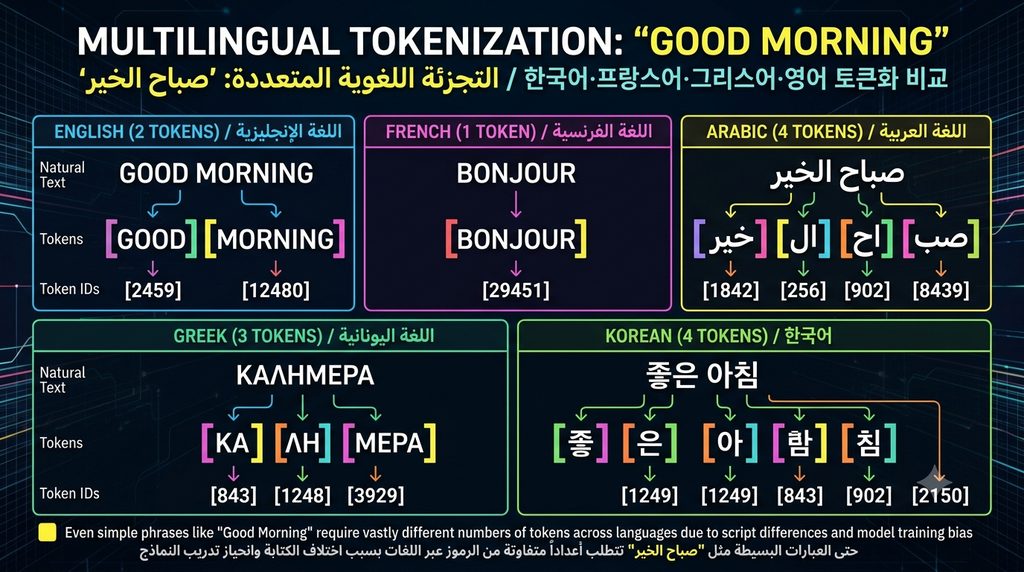
The same meaning can require substantially more tokens in a taxed language, ranging from roughly 1.2x to 6x for languages such as Arabic, Korean, Hindi and Greek, depending on the model and tokenizer. A chatbot in a taxed language can therefore require substantially more tokens — and potentially cost substantially more — for the same customer message than one operating in English.
2.Input, Output and Reasoning
Input, output and, where applicable, reasoning tokens can all contribute to usage. If a language requires more input or output tokens, the language-related cost difference can therefore affect more than the initial prompt. The magnitude depends on the model, task and pricing structure. This matters because output tokens can cost considerably more than input tokens, further amplifying the effect.

3. The Conversation Snowball
Many systems resend the full chat history with each new message, meaning that the resent conversation can be processed and billed again. A taxed language inflates that history faster, so costs can accumulate turn after turn.
4. AI Talkativeness
AI frequently produces more text than is strictly necessary. When that additional output is generated in a language with less token-efficient representation, the extra text creates an additional token burden. Even when the AI is expressing the same intended content, a less token-efficient language may require more tokens to express it.

The next two layers are not yet measured. They remain the hypotheses of Econoverta, pending direct testing.
5. The Capacity Constraint
Response quality is known to degrade as accumulated tokens grow, in any language — this is why providers recommend restarting long conversations. Because a taxed language fills that capacity faster per unit of real content, we infer it may hit degradation sooner than an equivalent English conversation. This is the fifth layer that remains an inferred thesis.
6.The Correction Loop

If the degradation increases faster in the taxed languages, as per the 5th layer of tax, then users may need more follow-up questions and corrections to reach a usable answer — each one billed, each one adding to the very history that triggered the problem
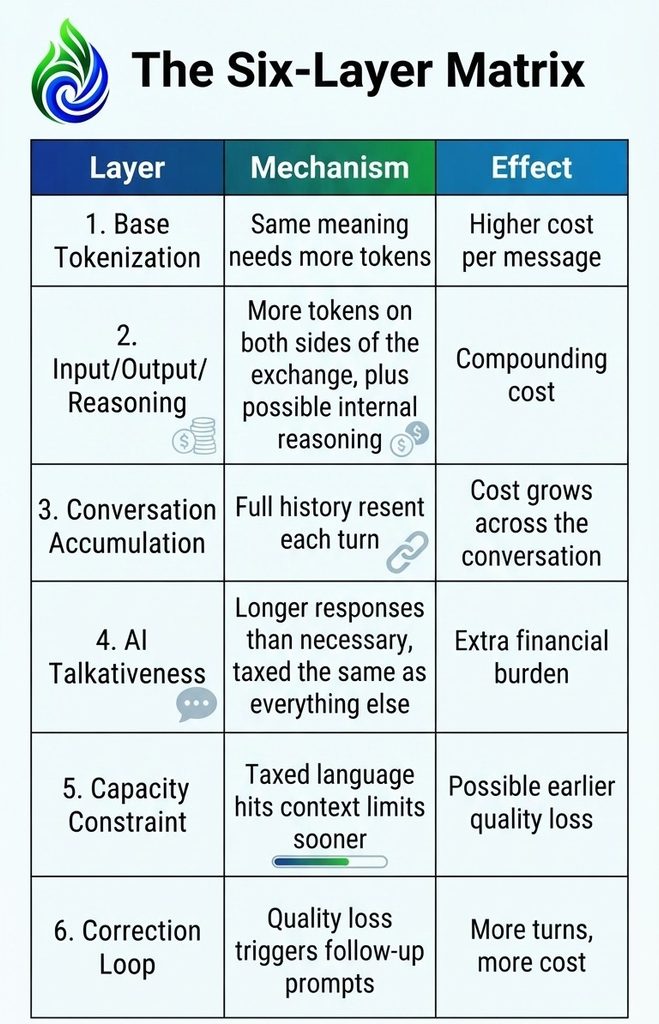
This six-fold chain reaction begins with one simple fact: some languages require more tokens than others to express the same meaning. It illustrates how the Language Tax can extend beyond simple token conversion into a compounding economic effect across the AI ecosystem. The size of each layer depends on the specific language, tokenizer, model and how the system is built.
It should also be noted that the Language Tax follows the language and its use, not a particular country per se.
Part 2: Who Pays the Language Tax?
The immediate bearers of the language tax can be anyone: a start-up fintech, an AI chatbot in a government institute, a geological research centre, a hospital, a school or a graphic designer sending prompts in their language. All may encounter one or more layers of the Language Tax. The burden can become even more significant if the user relies on limited mobile data rather than broadband.
Let’s take two non-exclusive examples for clarity.
A Greek Fintech Start-up versus British Start-up
The Greek language uses approximately 3x English tokens for the same meaning. The Greek start-up can be hit with the different layers of the language tax when setting up its system, and later on, during its operation. Building a Greek-language customer-support or compliance bot means that, prompts and tests can require roughly three times the tokens of equivalent English material.

Once it starts operating, every customer query sent and every response out can similarly require roughly three times the token volume of an equivalent English interaction.
So the Greek start-up’s AI-related costs can compound faster than those of a British counterpart as usage and conversations grow. The company may respond by operating on a thinner margin, charging customers more, capping usage more aggressively or under-investing in the quality of its Greek-language experience.
A Nepalese Geologist

Now picture a Nepalese geologist, whose language Devanagari uses anywhere between 1.3x to 4x tokens than English. He is studying the Himalayan terrain in his native language. He is using AI to analyze risks exposed by the 26 August 2026 catastrophe in Nepal.
To reach meaningful results, he will have to use many more tokens than a British, American, or Chinese geologist conducting the same research, while potentially reaching context or budget limits sooner.
This is a structural barrier to digital equity
On the International Level
The Language Tax scales with use. Countries bearing it may have to exert more effort simply to keep pace with global business, science and digital development — or risk falling behind.
Here are some of the potential effects:
Balance of payments:
AI services in most countries are purchased from foreign providers concentrated mostly in 2 countries. Therefore, with higher token consumption higher payments are made externally, than the amounts that efficient languages pay for the same tasks. The irony of it, is that many of the language tax bearing countries are developing countries, who may already be facing issues with their balances of payment.

Competitiveness:
Operators working in a more token expensive language can pay more to build and run AI services such as support centres, fintech platforms and e-government systems than competitors operating in a more efficient language. This can become a comparative disadvantage for these businesses.
Cross-border e-commerce and export services:
A Vietnamese- or Amharic-speaking exporter may face a hidden, non-tariff cost of market entry if AI-driven translation and customer support require more tokens than the equivalent service in a more efficient language.

Currency compounding:
AI services are often billed in international currencies. A country with a weak or volatile currency that also consumes more tokens for the same AI task faces both the higher token bill and the exchange-rate burden on that larger bill.
International development and aid:
Every dollar a less efficient language country wants to pay for AI-mediated health, education, financial, or developmental services will buy less AI services than in a more efficient language country. This imposes constraints on these countries’ efforts for development. In many cases, these can also be the countries where development resources are most constrained. This dilemma is regardless of whether the resources in question are the country’s own resources, or donations and aid.
Part 3: Business, Investment & Governments Implications
The layers described above carry direct consequences for anyone budgeting, investing or governing around AI in a high-tokenization-cost language.
For businesses and investors:
This multiplied cost needs to be evaluated carefully in any business or investment working in a higher-tokenization-cost language. They need to be aware that these may not be marginal amounts. These costs can compound on the balance sheet and may affect the very viability of a business as AI use scales.
For governments:
The same logic applies to public digital projects. Governments and non-profit organizations deploying educational, health tools in high-tokenization-cost language regions may receive less impact per dollar spent. Governments planning AI-dependent public services in these countries need to budget for this reality clearly, to avoid unexpected cost pressures and inefficient use of scarce public resources.
It is worth noting that some governments have moved to address this at the sovereign level rather than wait for the market to fix it. Saudi Arabia and the UAE have invested heavily in Arabic-first AI models. They provide these models for free to end users. Econoverta believes that in a subsidised or language-first-model free-to-user model, part of the cost may move away from the individual user and onto the public/private funding structure behind it. Whether this fully offsets the underlying tokenization disadvantage requires separate cost analysis.

The broader point is that making AI more accessible in a language other than English or Chinese, does not happen automatically at zero cost. The resources required to build the infrastructure and models still have to be paid for. But that is a subject for another Econoverta paper.
Conclusions
AI LLMs treat languages differently. Some languages require more tokens to express the same meaning than others. In a single sentence the difference may be negligible. But depending on the interaction with AI, this can build through six layers into a much larger potential cost over a long conversation and, eventually, across organisations, institutions and economies.
The first four layers describe mechanisms through which token inefficiency can increase usage and cost. The final two — the Capacity Constraint and Correction Loop — are a direct result of the first 4 and the way many AI models are built. However, this thesis needs to be put to the test.

This paper does not argue that every user of every less efficient language automatically pays for all the six layers at once. But It DOES argue that a small difference at a single prompt level for an image, conversation, or query can become economically significant when multiplied across inputs, outputs, conversations, users businesses, educational facilities, research center and economies as a whole.
Leave a Reply